058
EXHIBITED
Ibrahim Hussein: A Retrospective, National Art Gallery, Kuala Lumpur, 1986, illustrated on catalogue, plate 168.
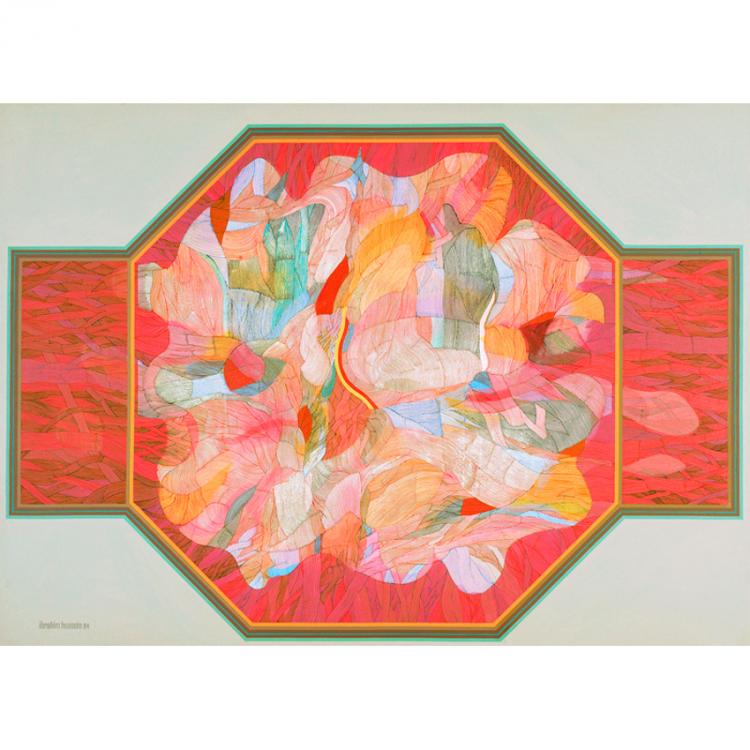
Under the spotlight is a rare gem by internationally acclaimed Malaysian artist Datuk Ibrahim Hussein – a 1979 acrylic on canvas titled Monorobos 1.
Ibrahim, or otherwise affectionately known as Ib – is arguably Malaysia’s most recognisable artist. He was trained at the Nanyang Academy of Fine Arts in Singapore, and then at the Byam Shaw School of Drawing and Painting before finishing at the Royal Academy Schools in London. He had received numerous awards and scholarships, including the Fullbright Travelling Scholarship and the John D. Rockefeller III Fund Fellowship, and in 1970, he became the first Malaysian to participate in the Venice Biennale.
One central motif can be seen throughout Ib’s impressive opus of work – the human figure. His early training in the British art schools had gave him a firm foundation in drawing the human figure. Ib’s figures had transformed from simplified and stylised shapes as seen in one of his earliest works Reclining Women (1957); to aerial views of semi-abstract figures entangled and rolling in fluid unending motions, suggesting scenes of struggle and tumult. Ib’s pictures were inspired by events of human struggle and conflict: demonstrations at Trafalgar Square, London in 1960, the 1969 racial riot in Malaysia, and the 1982 Sabra massacre. However, he was not concerned with the depiction of specific events directly or literally, but rather to convey universal statements on humanity itself. Ib once said: “My role as an artist is to portray man’s basic needs on planet Earth and humanity’s universal sharing in God’s little acre – the art of our time provides us ways of seeing, understanding, criticising, and appreciating the world which we live in.’
But Ib’s figures are not what set him apart from the rest; it is the distinctive ever-changing Ibrahim Hussein lines that have earned him such a high level of recognition. It was not until 1975, when Datin Sim, his wife, gave him a set of graphic pens that Ib’s canvases were filled with sensuous lines of varying weight, direction and character. The primary element of line has taken a whole different role on the pictorial surface, liberating the preconceived notions and fulfilling the roles of the other elements of form, shape and dimension customarily used in pictorial composition.
Monorobos 1, presented in a unique horizontal format spanning five feet long, is a superlative result of Ib’s earlier abstraction of figure and expressionism of lines, embodying Ib’s mastery and innovation in the balance of colours, forms and composition. A circle on the right one-third marker forms the focal point where a line from the left breaches it and where the trajectory of the inward momentum of the figures from the left and right meet. The image on ash-grey backdrop is boxed up by a thin rectanglular outline.
In an interview published in the New Sunday Times on March 13, 1986, he told journalist Ooi Kok Chuen that “life is a Monorobos, of human beings passing from one entanglement to another”.
Perfectly preserved by the owner, this work was acquired directly from the artist, and has remained in the private collection since for more than 15 years. Previously exhibited at Ib’s retrospective exhibition at the National Art Gallery in Kuala Lumpur in 1986, this precious painting has finally come to public view after 26 years.
Ibrahim Hussein was born in Kedah, Malaysia. He studied at Nanyang Academy Fine Arts in Singapore in 1956 and Byam Shaw School of Art and Royal Academy London in 1963 and 1966 respectively. He was awarded an Award of Merit scholarship which allowed him to travel to France and Italy. Ibrahim has had exhibition with Andy Warhol and Salvador Dali at the Dhalat Abdulla Al-Salam Gallery in Kuwait, 1977. He returned to Malaysia to become a resident artist at the University of Malaya. He founded the Ibrahim Hussein Museum and Cultural Foundation in the Langkawi rainforest – a non-profit foundation and museum dedicated to the promotion, development and advancement of art and culture.